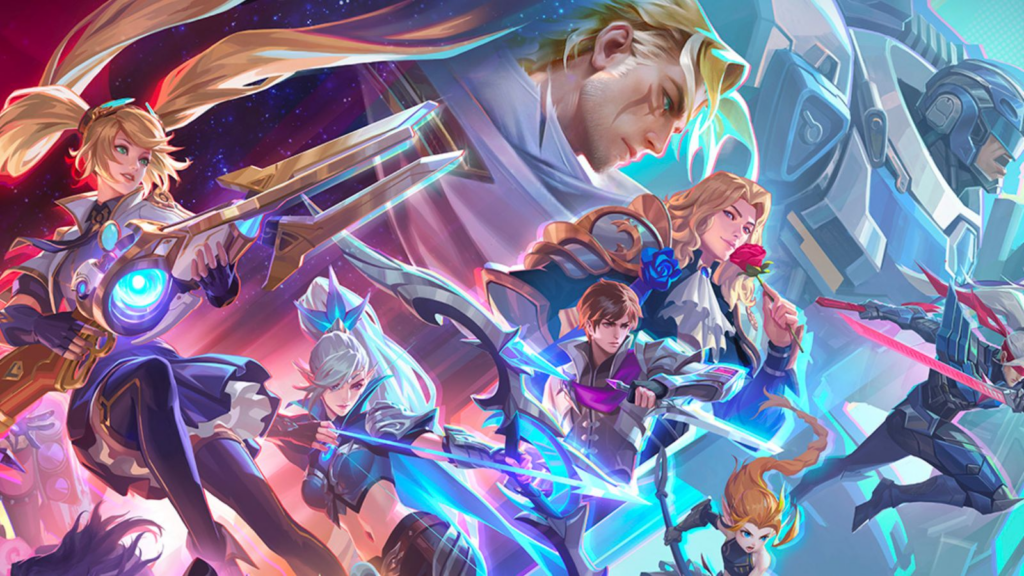
Mobile Legends: Bang Bang (MLBB) launched globally in 2016 and found extraordinary success in Southeast Asia (SEA), becoming one of the region’s biggest mobile esports titles.
Even as Free Fire led installs and Honor of Kings emerged as a major challenger, MLBB has remained SEA’s leader in engagement and revenue. It took a traditionally PC-heavy genre and made it accessible through shorter matches, low hardware requirements, and extensive optimization, lowering the barrier to entry for a new generation of MOBA players.
Over time, MLBB adapted itself to local cultures, turned casual play into community, and built an esports structure that gave players something to compete for. While its competitors can copy the mobile MOBA formula, reproducing the history, rivalries, and communities that have developed around MLBB is much harder.
MLBB was built for a mobile-first market
MLBB was particularly well suited to SEA because of its mobile accessibility and shorter match format.
For starters, SEA is a mobile gaming powerhouse, recording approximately 1.93 billion mobile game installs in Q1 2025 (Sensor Tower, 2025). Mobile devices also generate roughly 70% of the region’s gaming revenue and account for more than half of all hours played (Mordor Intelligence).
MLBB‘s success in SEA has also been unusually persistent. It remained among the region’s top five mobile games by downloads throughout 2017–2025. It ranked No. 1 in mobile-game revenue in six of the nine periods shown (Sensor Tower, 2025). MLBB also has over 35 million monthly active users (MAU) in Indonesia, 15 million in the Philippines, 10 million in Malaysia, 5 million in Thailand, and 1 million in Singapore.
MLBB lowered the barrier to MOBA play
Against that, MLBB offered a lower barrier to entry than MOBAs traditionally associated with PCs, such as Dota 2 and League of Legends. Instead of asking players to invest in expensive gaming hardware, Moonton optimized MLBB for mobile and made the genre accessible on devices that were already the preferred platform for play.
The format also fitted around how people used those devices. MLBB matches generally last 10–30 minutes, significantly shorter than PC MOBAs that can run up to an hour. More importantly, these shorter matches also gave MLBB players instant gratification, encouraging them to return (ISEAS-Yusof Ishak Institute).
The mobile gaming market in SEA became even more important during COVID-19, when restrictions disrupted access to traditional gaming spaces like internet cafes. For players already familiar with MOBAs, switching to MLBB felt like a natural transition. While that accessibility helped get players through the door, keeping them there required something more.
MLBB made itself locally relevant
MLBB has become a cultural symbol in SEA, with much of that success linked to the region’s gaming culture. Niko Partners reported that 87% of SEA gamers want some form of localization. MLBB did exactly that, going beyond simply translating text.
Instead, it brought extensive localized content and built a 130+ hero roster that includes characters inspired by regional history and folklore. Lapu-Lapu takes his name from the 16th-century Filipino chief who resisted Spanish colonization, Gatotkaca draws from the Javanese telling of the Mahabharata, and Badang is based on the legendary strongman of the Malay Annals.
Sensor Tower described this kind of hyper-localization as one of the keys to MLBB’s success, citing culturally relevant content, characters inspired by regional folklore, local tournaments, and community building.
However, localization extends beyond the game itself. ISEAS reported that Moonton adapts tournament operations to individual countries, including holding prayer ceremonies in Cambodia and Indonesia before event setups to respect local customs. These efforts have made MLBB feel local rather than simply available.

Bringing MLBB into popular culture
As MLBB’s characters and stories became tied to local culture, they also began reaching audiences beyond the game itself.
In September 2021, Moonton’s first animated series, Legends of Dawn: The Sacred Stone, aired on multiple television channels across SEA, following the hero Claude and his sidekick Dexter. That put MLBB’s heroes in front of audiences who had never touched the game and expanded the IP beyond the phone.
The relationship between MLBB and regional popular culture also worked in the other direction. Gatotkaca, now one of the game’s most recognizable heroes, was licensed in 2017 from Indonesian artist Is Yuniarto’s Garudayana comic series.
Moonton later published its own original title, Mobile Legends: Outlaw, in 2024, with a second animated series now in production. Together, these strategies helped make MLBB familiar even to people who had never queued for a match.
Community turned a popular game into a social space
Beyond cultural familiarity, MLBB understood the social importance of gameplay.
Indonesia arguably offered the clearest example. Playing games together is closely linked to the country’s “mabar” (short for main bareng) culture. MLBB’s 5v5 competitive format naturally fits into that behavior, turning ranked matches into something that friends can share rather than a purely individual progression system.
This social emphasis is supported by Niko Partners’ report, which found that 52% of SEA players watch gaming livestreams, while more than 45% want social features, such as in-game chat, rankings, or scoreboards. Beyond that, MLBB also makes competition feel local.
Rather than measuring MLBB players against an anonymous global ladder, local leaderboards allow them to compare themselves with players from their own town or city. A 2025 analysis from Universitas Brawijaya’s ASEAN Society Community described the game’s evolution from simple entertainment into a genuine cultural connector for the region’s youth.
- “Honor of Kings had its biggest year yet”: As HoK grows outside of China, the PC vs. mobile MOBA clash is heating up
- Janicka Gaming on bridging PUBG MOBILE’s community and its esports scene
- “Our preparation was pretty intense”: How Team Vitality’s MLBB roster breaks stereotypes about mobile gaming and women’s esports
Ranked play became national pride
Moonton began building MLBB’s competitive structure relatively early in the game’s life.
The first MLBB Southeast Asia Cup was held in 2017, before the Mobile Legends Professional League (MPL) circuits launched in Indonesia, Malaysia, and Singapore later that year. The Philippines followed with its own MPL in 2018.
What started with a regional competition soon developed into a much larger ecosystem. Today, MLBB has domestic MPL leagues, the Mid Season Cup, and the M-Series World Championship, providing a clear pathway from local competition to international play. MLBB has even been a medal event at the Southeast Asian Games since 2019, giving it legitimacy that outlasted any individual tournament.
Moonton also invested in grassroots tournaments, giving regional players opportunities to become local celebrities and teams the chance to establish their own fanbases. Even fans are kept engaged at MLBB tournaments, predicting match outcomes in exchange for limited skins and voting for their favorite regional team.
For SEA audiences, MLBB offered something other esports often cannot: the chance to watch familiar players and teams compete while representing their home markets.

Philippines vs Indonesia became MLBB’s defining rivalry
As the competitive ecosystem matured, those regional identities began colliding on the international stage – and few illustrate this better than the Philippines and Indonesia.
Filipino teams have dominated the M-Series since M2 in 2021, triumphing at six straight world championships through Aurora Gaming PH’s M7 victory in January earlier this year. More recently, the Philippines-Indonesia rivalry has become a fixture on MLBB’s biggest stage.
The last three M-Series World Championship grand finals have all featured teams from the two countries: AP.Bren against ONIC Esports at M5, Fnatic ONIC Philippines against Team Liquid ID at M6, and Aurora Gaming PH against Alter Ego at M7.
Aurora’s 4–0 victory over Alter Ego in Jakarta extended the Philippines’ winning streak. Still, repeated meetings between the two countries have given international MLBB a recognizable regional rivalry that a game update simply cannot manufacture.
MLBB’s audiences show the scale of its esports dominance
Those rivalries and established leagues turn regional loyalty into sustained viewership. In fact, the scale of MLBB’s esports audience is evidence enough of how powerful that combination has become.
According to Esports Charts, the MLBB M7 World Championship reached roughly 5.68 million peak viewers during its grand final in January 2026, growing 37% from M6 the previous year and becoming the most-watched mobile esports tournament of all time. More impressively, the huge audiences are not limited to global events.
MPL Indonesia Season 17 reached almost 3 million peak viewers, the second most-watched esports tournament in the first half of 2026. Meanwhile, MPL Philippines Season 17 peaked at around 1.69 million during its grand final. This shows that millions of viewers follow the regional leagues and teams all the way to the international stage.
MLBB’s hardest advantage to copy
MLBB’s biggest competitive advantage today is one that cannot be downloaded, developed, or copied. Competitors can reproduce its basic formula, offer better graphics and new heroes, or even build a technically stronger mobile MOBA. But none of that can recreate what MLBB has accumulated outside the game itself.
Nearly a decade of growth has created a layer of social capital that an MLBB competitor cannot build overnight. Millions of players already have friends in the game. Professional teams have established fan bases. Players have become celebrities whose names are recognized across borders.
Beyond that, there are domestic leagues with their own histories, rivalries, and storylines that fans have followed across multiple seasons and international championships.
Arena of Valor and League of Legends: Wild Rift illustrate how difficult it is to challenge that position. Both entered the mobile MOBA market with major publishers behind them, but neither has managed to displace MLBB’s position at the center of Southeast Asia’s mobile esports ecosystem.
As MLBB’s community has grown, simply offering a similar — or even technically stronger — alternative has become less likely to persuade players to start over elsewhere.
Why MLBB became Southeast Asia’s defining esport
MLBB‘s dominance in Southeast Asia was never the result of a single feature, hero, or tournament.
Its mobile-first design gave it the right foundation at the right time. Localization helped the game feel familiar across very different Southeast Asian markets. Its social features turned playing into a community activity, while professional leagues gave those communities players, teams, and national rivalries to support.
Over time, those advantages began reinforcing one another.
That is why MLBB‘s history may now be more important than any individual feature inside the game. Competitors can replicate the mobile MOBA formula, but they cannot recreate overnight the friendships, fanbases, rivalries, and shared moments that players have accumulated over almost a decade.
REFERENCES
- Southeast Asian Mobile Game Market Insights 2025 (Sensor Tower, 2025)
- Southeast Asia Gaming Market Size and Share Analysis (Mordor Intelligence)
- Is Mobile Legends: Bang Bang Indirectly Deepening Chinese Soft Power in Southeast Asia? (ISEAS-Yusof Ishak Institute)
- SEA of Opportunities: Exploring the Rise of the Southeast Asia Video Games Market (Niko Partners)