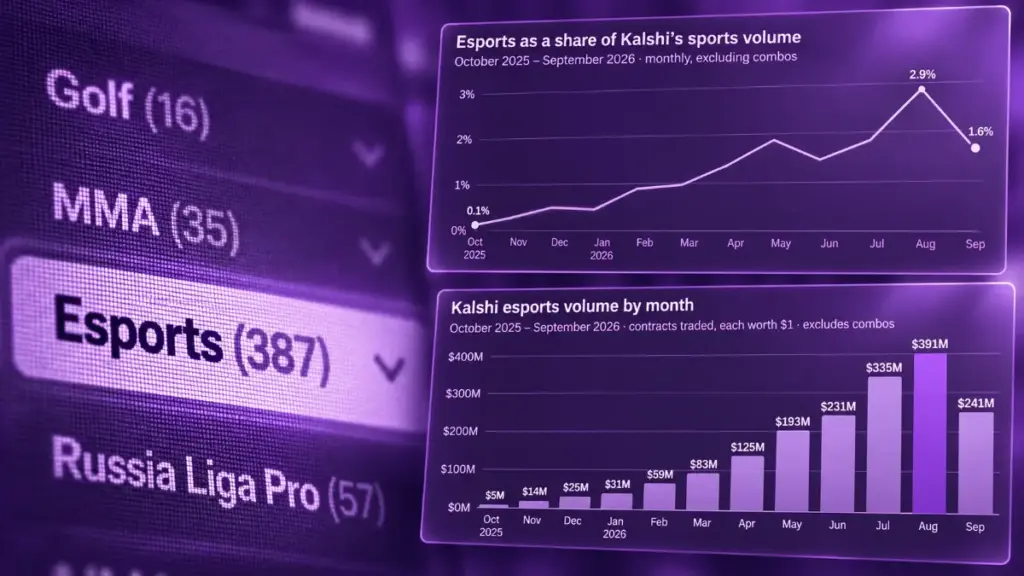
On Kalshi, in no month prior to October 2025 did esports contracts trade more than $0.4 million. In August 2026, they peaked at $391 million on the platform . In the twelve months to September, esports volume on the platform totalled $1.73 billion.
It’s a small part of a vastly larger machine, but it’s enough to show that interest in esports still exists — despite what the naysayers may tell you.
The year of the Prediction Market
If we replace the Chinese Zodiac signs with gambling-buzzwords, 2026 is well and truly the year of the Prediction Market. Prior signs may include: NFTs, crypto, online poker, sweepstakes, social casino. The list could increase ad infinitum. If I were a trader, I’d be trading yes for “rip pulls” to be 2027’s hot topic.
If you’re in or around the gambling industry, then you’ll be well accustomed to literally only reading about Kalshi, Polymarket, and the growing gaggle of operators vying for a slice of the pie. They’re vying for a slice in between being sued by state gambling regulators, suing state gambling regulators, and largely doing whatever they want because of the frankly bonkers regulatory system over in the United States.
Still, prediction markets data is available via API, and if you’ve got time and a decent grasp of what you’re looking for, it can provide some interesting takeaways and signals. They’re not as ironclad a “truth” signal as Donald Trump Jr. will have you believe, but they still throw up data, and data is certainly helpful for interpreting consumer behaviour.
Kalshi esports volume exploded adjacent EWC, major tournaments
The platform’s first esports offering in autumn 2025 was a single “who will win League of Legends Worlds” market. This fits our data pull: League of Legends made up almost all of the $5.2 million traded in October 2025.
Single-match markets followed across Counter-Strike 2, League of Legends, Valorant and Dota 2, and volume has climbed almost every month since. The platform traded $44 million of esports in the fourth quarter of 2025, $173 million in the first quarter of 2026, $549 million in the second and $967 million in the third.
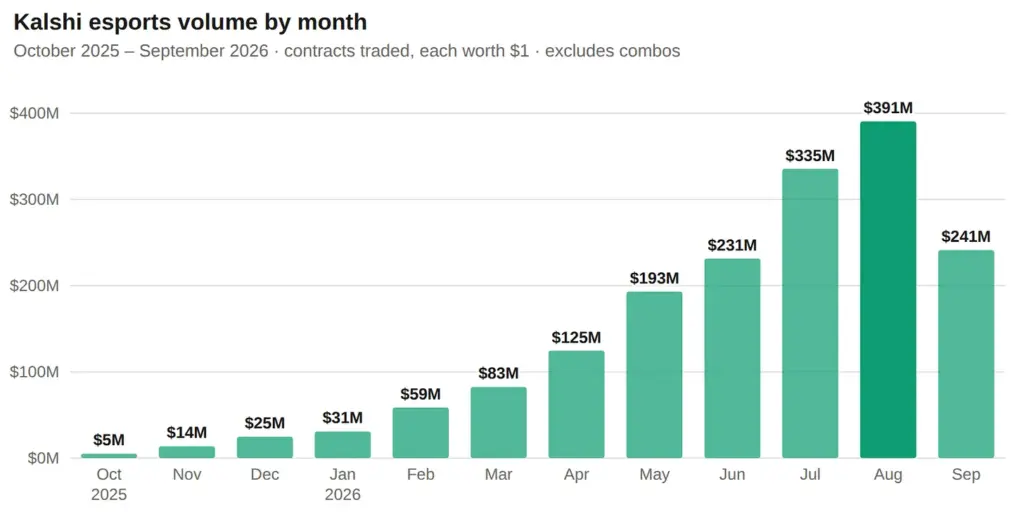
It doesn’t take a rocket scientist to know that volume spikes with the biggest events. This was shown with the mammoth trading volume on soccer during the FIFA World Cup. In esports, it seems that the trend is not dissimilar, although I would suggest there is strong underlying growth, complemented by spikes around major events.
June included the IEM Cologne Major (Counter-Strike). August had the Esports World Cup (CS Finals) and Dota 2’s The International. The combination of two large events in August produced the peak, and North America’s love of Counter-Strike meant that June produced impressive numbers too.
Exponential growth, but a teeny, tiny slice of a very large platform
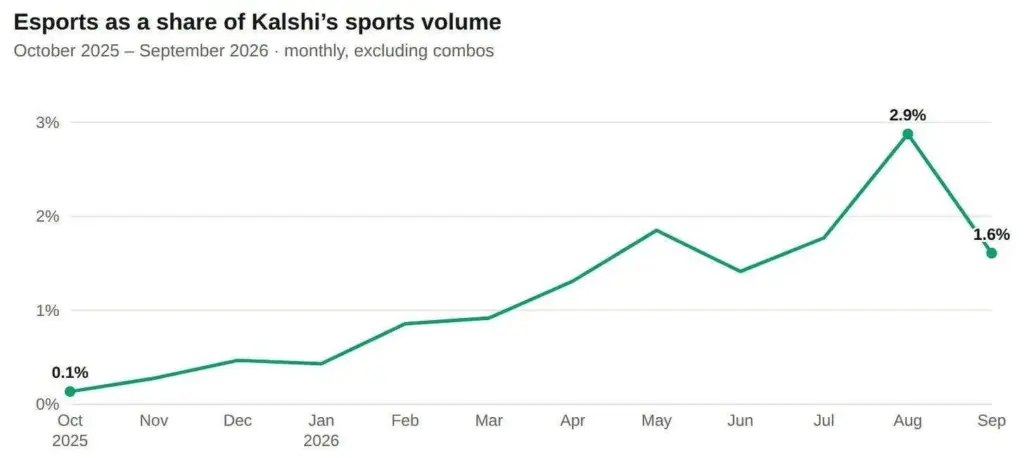
Esports is definitely growing quickly from a minuscule base, and, as such, framing it within a broader Kalshi picture is important. In October 2025, esports was 0.1% of Kalshi’s sports volume (excluding combos).
At its peak in August, esports accounted for 2.9% of Kalshi’s single-leg trading, which fell to 1.6% in September. Kalshi’s business is absolutely dominated by combos, with people stacking contract after contract into a multi-leg concoction chasing big returns for minuscule stakes.
It’s basically a speculative accumulator — and UK readers will be familiar with the feeling of sticking a 12-leg both teams to score accumulator on in search of some dopamine every weekend only to never win a bet. Parlays accounted for 58% of all platform volume in September.
As always, it’s important to clarify that volume traded on a prediction market is not directly comparable to the handle reported by sportsbooks. It counts contracts traded, and trading in and out of a position therefore makes the number rise without any additional cash going in.
In their inception, prediction markets were touted as a niche for political and economic forecasting. With the advent of sports betting contracts, they quickly became a mainstream way for people to engage in trading the outcome of sports in the United States and are not bound by state-by-state gambling regulation. Esports, as a ‘sport’ in its own right, is following.
Polymarket signed a partnership with tournament organiser BLAST, and it has been reported that Riot Games is weighing up partnerships with Kalshi/Polymarket. Kalshi has also recently taken to social media looking to recruit someone to lead its go-to-market strategy in esports.
For those within esports, the more immediate value lies within the data — even if it’s just for validation. Volume traded on an event is a fairly good barometer as to how much attention it commanded. With Kalshi, this is to a largely US audience. It provides data for tournament organisers, publishers, and sponsors to sit alongside viewership data, helping show that esports is more than just an echo chamber that prides itself on people yelling very loudly about the future. Or perhaps it just helps people yell louder.
League of Legends Worlds will provide significant interest
I have no doubt that League of Legends World Championships will drive some pretty impressive volume. Given the event is taking place in the United States, it will provide a good barometer of how much interest there is.
Traditionally, from my analysis, Polymarket (Global) has been the home of most League of Legends trading, so I’ll be keeping a keen eye on the numbers as we progress through the next month. I’ve included a tracker in my Substack for those interested in the (very) early data.