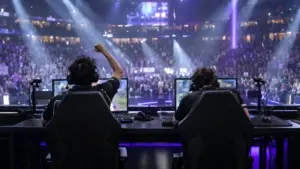


The North American Challengers League – North America’s League of Legends Tier 2 system – is in its home stretch.
Six teams remain in the NACL Summer Playoffs, but the prize isn’t merely a trophy. The top two teams qualify for the League Championship Series’ promotion-relegation tournament, set to happen later this year.
The finalists in the NACL Playoffs will join a pair of Liga Regional Norte teams and current LCS guest spot holder Disguised in a five-team event to qualify for North America’s Tier 1 system.
The lure of playing on stage in the LCS is enough to excite Cupid Esports coach Samuel “boc” Boudrie and his players.
“I was in China coaching team for the Asian Games back in 2023, and being up on stage and just in front of people, having that screen, the computer, seeing the other team sitting across from you, like there’s like this electric feeling,” boc said to Esports Insider. “And once you have that, you want more.”
But the question becomes: Is it realistic? Sure, winning the promotion-relegation tournament gets you the spot, but once the trophy is raised and the confetti has fallen, there will come a new challenge.
“It’s not something I suppose that I can wrap my head around right now,” Contingent owner Jose “beardsandcats” Graham said.
Note: For simplicity purposes, this article will only cover teams that can qualify as listed professional organizations. In the case Winthrop or Marysville win or finish second in the NACL, neither team can move into the LCS, as both are collegiate programs and are ineligible for qualification.
The price of getting there

Once a team earns qualification, the clock begins.
Teams in the promotion tournament will be audited to determine whether the organization has the financial resources to play in the LCS.
The LCS and Riot Games require players to be listed as full-time employees of the company, meaning they must be W-2 employees with health insurance benefits. The LCS player minimum is $75,000, which is also the LCS-mandated minimum, but add in all the external benefits, and the number could easily escalate into six digits.
Additionally, boc estimated that teams receive 50% less in their Riot-sponsored stipend than the franchised teams – the other seven teams in the LCS.
A person with knowledge of the finances of what the guest spot entails wouldn’t elaborate on the exact percentage, but said the difference is “significant” and could be more than a million dollars.
Then comes the additional cost of moving a team’s operations to Los Angeles, where most of the year’s games are played. The cost could escalate if they desire a quality setup, which may need to be covered upfront as the stipend comes at specific times of the year.
The same person estimated the start-up cost for a new LCS team at a little more than $400,000, though the figure hasn’t been independently confirmed.
“There’s so much I didn’t consider,” beardsandcats said.
Getting there with the finances is one thing, but staying up also has its own set of challenges.
No rest for the promoted
Disguised defended its guest spot in 2025 by winning the promotion tournament.
The core of the team – Isaac “DARKWINGS” Chou, Cho “Rahel” Min-seong and Choi “huhi” Jae-hyun – was then poached by Sentinels for the 2026 year, and jungler Lawrence “eXyu” Xu left for Dignitas.
It meant Disguised, despite maintaining its spot in the LCS, had to replace 4/5 of its team for 2026.
“An LCS team will come and pick up one of your players, and now all of a sudden, all that development work you’ve been doing is gone,” boc said.
He offered a less-than-ideal solution, but it could be better than the current system.
“Or [our salaries are] going to be so little…basically enough so we can get you to sign an exclusivity contract with the buyout,” boc said, “so the [other teams in the] LCS can’t just floss us or fleece us for everything when they poach our players.”
This is the reality for teams in the LCS guest spot.
Disguised – or any one in the guest spots – could qualify for Worlds in any year but still have to fight for its spot, meaning players are less likely to sign long-term deals that franchised teams like Cloud9 Kia and Team Liquid Alienware can offer.
“[Disguised] has to fight for relegation no matter how well they do,” boc said. “It’s just a lose-lose scenario here.”
It leaves the teams with a potentially revolving door of players, which in any sport, does more harm than good.
Are fixes on the horizon?
The system, as is, remains a point of contention.
“Promotion-relegation used to have value because teams could develop and sell their spots for significant amounts of money,” Global Head of LoL Esports Chris Greeley said during a roundtable at the Esports World Cup. “We moved away from that because we didn’t think it was the healthiest model for the ecosystem, and we wanted Tier 2 to focus on developing talent.
“But talent development is difficult to sustain. There’s not a lot of money in it unless teams can sell players or contracts, and the market wasn’t compensating Tier 2 organizations for the investment they were making.”
Additionally, while LCS viewership is on the decline/lower end, the viewership for the NACL is significantly lower, making it difficult to convince sponsors to invest in the Tier 2 system when Tier 1 is available as well.
“It’s difficult to attract sponsors to Tier 2 when they can invest in Tier 1 and reach more people,” Greeley said. “We’re trying to find ways where an organization can look at Tier 2 and say, ‘We’re developing talent, which is good for the ecosystem, but this also makes sense financially for our team.'”

So, while Riot and organizations like the Esports Foundation explore ways to raise the funds to build a healthy and established Tier 2 system, the promotion-relegation in North America remains in play.
But how can they make it more beneficial for teams to want to move into the LCS without fear, boc suggests that the guest spot could receive more of the Riot stipend, which may be easier said than done.
“I’m pretty sure it’s the other teams that are part of the franchise that are saying, ‘No, we’re not willing to give up more of our share to give this new team some extra Riot stipend,’” he said.
But aside from player salaries, Tier 2 isn’t necessarily developing players at its maximum efficiency. Players are still expecting to scrim and practice five to six days a week, but were making enough to cover living expenses. Over the years, players saw salaries shrink, but were still required to practice while holding another job or even attending school.
“It’s just not sustainable,” boc said.
Another solution beardsandcats offered is a bit more drastic – remove franchising altogether.
“Dream world…would be that Riot continues to support the scene the way that they do at LCS level, but doesn’t have franchising,” he said. “Just the worst team has to relegate, not necessarily the one team that found themselves in has to compete every year, no matter how well they do.”
Greeley hinted that Riot might be exploring ways to overhaul Tier 2.
Whether it’s soon or not remains to be seen.
Cross that bridge later
The four remaining organizations that can be promoted from the NACL to the LCS are Contingent, Cupid Esports, Conviction, and NRG.
From the coach’s perspective, the worry about the financials and other items isn’t on their minds.
“Our goal was always to try and promote into LCS,” boc said. “But if you start thinking that you’re already there, you focus too much on that, you miss all the steps that go along the way. We’re not trying to think about it too much because we don’t want to get distracted.
“That’s happened to teams before that have been really good that I’ve been a part of.”
Despite the fact they’re still in the conversation, beardsandcats doesn’t plan on losing sleep over the idea until it becomes closer to a real possibility – meaning his team reaching the NACL Playoffs Finals and taking the stage for the LCS spot.
He called all the elements needed to make it all happen “worrying,” given how much time he already spends on his organization in Tier 2.
“There would be a lot of changes that would have to happen for us to make it work,” beardsandcats said. “I would be stupid to try and sell it off. If I can figure out how to make it work, I will make it work.”
So how exactly will he make it work?
“It wouldn’t even be a little tight [financially]. It would be grabbing some rocks outside and putting some water on the kettle because that’s where I’m getting my nutrients for the day,” beardsandcats said.
The thoughts of hot rock tea can wait, though.
The first step is to be in the position to get there.