TL;DR
- There are 25 VALORANT ranks split between nine different tiers.
- You’re eligible to play VALORANT ranked after playing 20 unranked games.
- You can improve your VALORANT rank by practising in firing range or mastering an agent.
- There is no VALORANT rank decay; however, placement matches are part of keeping rank.
If you’ve thought about starting your competitive journey and wondered how VALORANT ranked works, you have come to the right place. We’ll break down all the different tiers, how to improve at the game, how the rating system works, and everything you need to know about matchmaking and maintaining rank in 2026.
Compared to most PvP games, the VALORANT ranking system tends to be more in-depth. Progression can feel more linear in VALORANT, with the climb up the chaotic, ranked ladder feeling intense.
With that said, we’re analysing the VALORANT ranked requirements to start your ranked grind and what to expect in that grind. You must be level 20 before starting ranked, however.
VALORANT ranks & tiers
So, what are the VALORANT ranks?
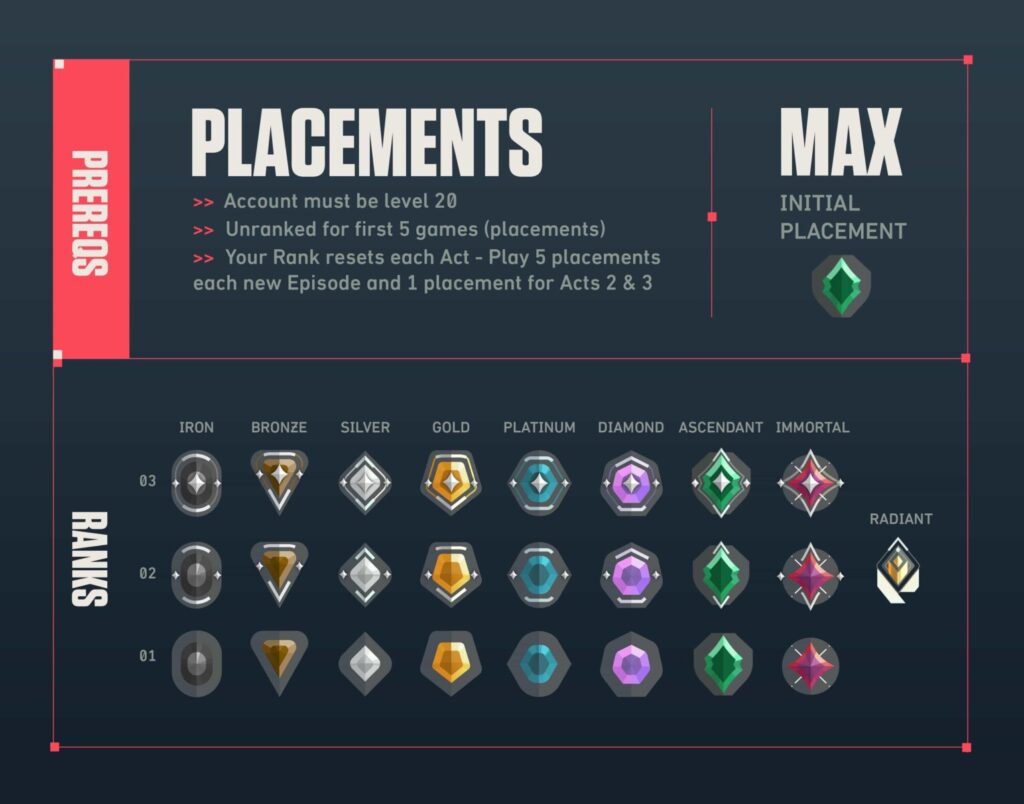
There are 25 VALORANT ranksin the game, which are divided into nine distinct tiers named after metals and concepts.
It goes as follows: Iron, Bronze, Silver, Gold, Platinum, Diamond, Ascendant, Immortal, and Radiant, with three tiers to each section except for the final ranking.
Everyone starts at the bottom, with the lowest VALORANT rank, Iron. Depending on how well you perform and your win percentage, you’ll start climbing the ladder, but it can take longer than expected when compared to other esports titles.
All VALORANT ranks in order
| Rank | Percentage of players in each rank |
|---|---|
| Rank | Percentage of players in each rank |
| 🔗 Iron 1 | 1.17% |
| 🔗 Iron 2 | 2.28% |
| 🔗 Iron 3 | 3.26% |
| 🥉 Bronze 1 | 6.41% |
| 🥉 Bronze 2 | 6.44% |
| 🥉 Bronze 3 | 5.14% |
| 🥈 Silver 1 | 8.56% |
| 🥈 Silver 2 | 7.26% |
| 🥈 Silver 3 | 5.85% |
| 🏅 Gold 1 | 8.82% |
| 🏅 Gold 2 | 6.98% |
| 🏅 Gold 3 | 5.17% |
| 💠 Platinum 1 | 6.98% |
| 💠 Platinum 2 | 5.00% |
| 💠 Platinum 3 | 3.49% |
| 🔷 Diamond 1 | 4.55% |
| 🔷 Diamond 2 | 3.21% |
| 🔷 Diamond 3 | 2.17% |
| 💚 Ascendant 1 | 2.86% |
| 💚 Ascendant 2 | 1.81% |
| 💚 Ascendant 3 | 1.07% |
| 🔴 Immortal 1 | 1.06% |
| 🔴 Immortal 2 | 0.27% |
| 🔴 Immortal 3 | 0.15% |
| 💎 Radiant | 0.05% |
How the VALORANT ranking system works
VALORANT’s ranking system is based on your in-game win rate, how well you play, and how consistently you perform. It takes some time to climb through the ranks, as the system takes the rank rating (RR) points into account every time you win (or lose) a game.
You’ll gain higher amounts of RR by winning consistently, as you would expect, but losing in competitive modes will give you some, too. Like with most things, consistency is key to steadily climbing the ladder rather than purple patches spliced with failures.
VALORANT ranking is faster at the lower ranks and then slows down the higher up the chain you go, which is to be expected.
- You start with 50RR and then need 100RR to be promoted from Iron 1 to Iron 2.
- With each promotion, you’ll need a minimum of 10 RR, which is consistent from Iron to Ascendant.
- Things change with Immortal and Radiant, where more than 100 RR is needed for progression, and only the top 500 players per region can hold the top rank.
Rank distribution in VALORANT

According to Vstats, the VALORANT rank distribution has resulted in most players sitting in Bronze, Silver, and Gold, with Bronze 2 being the most populated rank in V26 act 1 at 9.84%. Bronze is also the most populated tier overall, and this is likely because the season is closer to its start, as of writing.
Beyond Gold, ranking in VALORANT thins out, each tier getting exponentially less populated, especially beyond Platinum.
This trend eventually leads to the least populated and highest VALORANT rank, Radiant. As of mid-January, 2026, only 0.02% of the competitive playerbase are in this category, which is considerably less than the lowest rank, Iron 1, at 0.76%.
How to rank up faster in VALORANT
Like with almost any competitive game, there aren’t any shortcuts to ranking up in VALORANT outside of someone carrying you. If you’re looking for things you can control, here are some tips and tricks to help you rank up and improve in VALORANT, predominantly by improving game sense, movement, and practising your aim in the firing range.
Getting used to VALORANT’s movement is vital, being slower and more deliberate than other hero shooters and more in line with CS2. Each weapon has heavy recoil, so firing in short, controlled bursts often leads to higher accuracy. It also helps to learn the maps, too, and common strategies on certain maps.
With 28 VALORANT agents, divided into four classes, it’s important to understand how each role works and how characters match up with one another. While the individual match-ups should be studied, here is an overview of the VALORANT classes:
- Duelists tend to be best in 1v1s, direct combat situations, and entering sights, because of high mobility.
- Initiators are typically the most useful for obtaining information, using traps or cameras.
- Controllers control areas, hence the name, slowing enemy movement or restricting visibility.
- Sentinels are the defenders, creating chokepoints to prevent enemies from entering sites.

Abilities are mapped to Q, E, C, and X on the keyboard alongside the standard shooting, which helps the game stand out from the competition.
As with many FPS, improving communication is one of the key ways to getting better at VALORANT, especially because it is completely separate from improving mechanically. Being responsive in voice chat and, if not, game commands will help you coordinate with your team and become a team player, rather than aiming to be the solo carry. This will make you a more well-rounded player and help your team build strategies.
Trying not to be toxic also helps with communication. Yelling hostile insults is useful to no one, but keeping chat positive and tactical will always provide some kind of benefit.
And, of course, playing VALORANT ranked matches is the only way to move up the ranks, although a warm-up quick game before a ranked run is always recommended.
Before entering ranked for the first time, you must play 20 unrated matches first.
Remember that stat-padding and getting as many kills don’t win you games. Being a team player and doing what you can to win matches is what will make you rank up, rather than being the best on a losing side. Of course, there’s nothing wrong with being the best on a winning side, but if you’re getting the kills while communicating efficiently, not a lot can stop you. The best way to get to this state is to learn from wins and losses, correct mistakes, or reinforce what worked.
Playing with friends or people you know instead of randoms always helps make communication more natural, too.
VALORANT rank decay & placement matches
Many competitive games suffer from decay, where your rank will decrease after periods of inactivity. VALORANT rank decay does not occur, meaning you can take as much time away from the game as you’d like and your rank won’t be impacted.
However, you may find that your hidden Matchmaking Rating (MMR) can change after periods of inactivity. This means that despite your rank not actually changing, the types of matches you’ll be placed into can be different from the ones you’re used to.
MMR is used to determine your skill level and then places you in games with those who have similar capabilities. MMR can drop after periods of inactivity, which won’t change your rank but may place you in lower average rank games.
When first playing ranked mode, you’ll have to play VALORANT placement matches, which consist of five provisional matches that will adjust your MMR more heavily so that you’re playing in the right matches. These can also occur after inactivity, as well as at the start of every season, to keep the game balancing consistent.
You can prevent your MMR from adjusting by ensuring you’re hopping into games frequently rather than taking long periods of time away from the game.
Conclusion
While ranking in VALORANT can be an intimidating process, initially, because of the number of ranks and time to take to progress, it can be a rewarding experience. Once you’re ready to embark on your competitive journey, beginning at Iron 1, you’ll be able to climb the ranks of Silver, Gold, and maybe even all the way up to Immortal and Radiant.
Most players tend to sit comfortably at the Silver and Gold tiers. You can advance if you put in the time, practice, effort, and you have the talent for it. Maybe one day, you too can join the ranks of the pros.
If you want to get involved in the esports scene and get a look at how the pros play the game, check out our VALORANT esports coverage. We cover new competitive map developments, the teams competing, events, and all the latest news. Those wanting to take VALORANT seriously should have a look at the highest level to see what they can learn.
FAQs
What ranks can play together in VALORANT?
The different VALORANT ranks playing together depend on the party size. With parties of two or three, Iron and Bronze can play with up to Silver, Silver can play with Gold, and Gold can play with Platinum. However, there are no restrictions with parties of five players. However, parties of four cannot play ranked VALORANT together.
Is rank 1 or 3 better in VALORANT?
Each VALORANT tier (except Radiant) has three levels, with 1 being the lowest (and worst) and 3 being the highest (and best).
What rank is the top 10% of VALORANT players?
The top 10% of VALORANT players span the Radiant rank (the highest), down to Diamond 2.
Can Bronze 2 play with Gold 1 VALORANT?
No. Bronze players cannot play with Gold players, but they can play with Silver players.
How do I calculate your MMR in VALORANT?
You cannot see or calculate your MMR in VALORANT, as it’s a hidden figure, but you can best guess your skill level by looking back at your rank rating (RR) gains and losses.
What is the average VALORANT rank?
The two biggest VALORANT ranks by percentage are Silver 1 (9.11%) and Gold 1 (8.76%), with the two tiers holding the highest averages.
What level do you have to be to play ranked in VALORANT?
To unlock ranked (competitive) mode in VALORANT, you must have a level 20 account and win 10 unrated matches.